
MESRAP applies to investment funds that are required by DNB to submit macro-economic statistical reporting. AIFMD-light managers should not assume that AFM registration automatically covers DNB statistical reporting. Each fund should be assessed for DNB registration, assigned MESRAP profile, reporting frequency and quarterly or monthly deadlines.
Many AIFMD-lightmanagers assume that MESRAP does not apply to them. Not because they deliberately ignore the obligation, but because they have simply never had to deal with it before. In the past, there was also a practical explanation for this: DNB statistical reporting largely relied on self-registration. Those who did not actively register with DNB sometimes did not see a direct reporting obligation either.
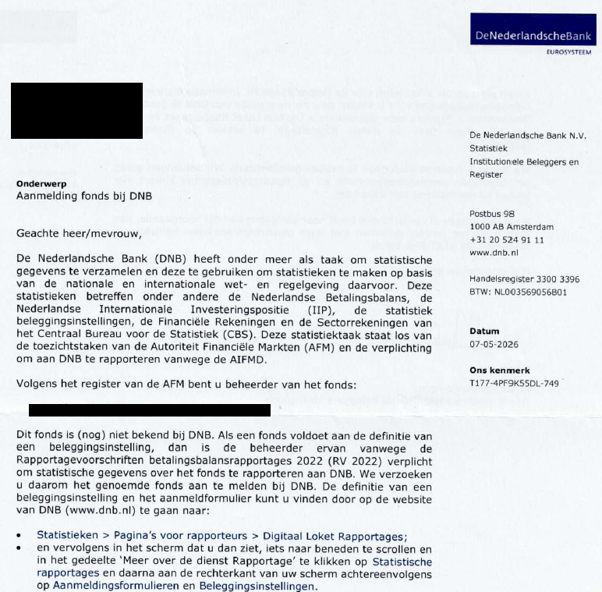
In practice, that situation appears to be changing. DNB is taking a closer look at the investment fund population and regularly sends managers a request to register funds forMESRAP or related statistical reporting obligations.
MESRAP applies to investment funds that are required by DNB to submit macro-economic statistical reporting. AIFMD-light managers should not assume that AFM registration automatically covers DNB statistical reporting. Each fund should be assessed for DNB registration, assigned MESRAP profile, reporting frequency and quarterly or monthly deadlines.
DNB collects data for macro-economic statistics. For this purpose, DNB has a separate registration form for investment funds. Based on that form, DNB determines the reporting method and reporting frequency. DNB also explicitly states that Wft exemptions, for example regarding the minimum participation amount, number of participants or type of investors, do not automatically mean that an investment fund falls outside DNB reporting. See DNB's page on registration forms and investment funds.
MESRAP stands for Macro-Economic Statistics Reporting. The Dutch Central Bank (DNB) uses this reporting framework to collect data for macro-economic statistics, such as sector accounts, the balance of payments, the international investment position and sector statistics.
For investment funds, the legal basis includes but it is not limite to the European regulation on statistics concerning investment funds, Regulation (EU) 2024/1988. This legislation requires investment funds to report detailed financial data to national central banks, such as De Nederlandsche Bank (DNB). The national banks will share the data with the European Central Bank (ECB) . The data is than used when shaping the monetary policy within the euro area.
MESRAP can be broad. Depending on the reporting profile, DNB may request data on, for example:
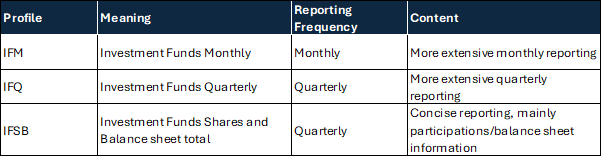
Not every institution receives the same reporting request. DNB works with reporting profiles, which are assigned based on the financial sector to which an institution belongs and/or based on the institution's specific activities. For investment funds, the following MESRAP profiles are particularly relevant:
For AIFMD-lightmanagers, the reporting request is often more limited in practice than for large or complex financial institutions. In the MESRAP manual, profile IFSB is described as a concise report for smaller investment funds.
That concise report mainly concerns issued participations of the fund. A distinction is made according to the type of the account holder/investor:
*MMF = Money market fund = a fund that mainly invests in short-term, liquid money market instruments, deposits and similar instruments.
Depending on the type of investor, a breakdown must be made by sector, country and sometimes the name of the institutions holding position in the fund is required. The report works with a reconciliation between opening position, issuances/inflows, redemptions/outflows, valuation movements, other movements, corrections and closing position.
In practice, AIFMD-light managers are often assigned the IFSB profile, although the DNB letter and the reporting obligation in Mijn DNB remain leading. IFSB is a quarterly reporting profile. This means that MESRAP will generally need to be filed four times a year. For quarterly reporting, the filing deadline is generally the 15th business day after the end of the reporting period. For monthly reporting profiles, the deadline is generally the 30th calendar day after the end of the reporting period.
According to the DNB reporting calendar for 2026, the quarterly filing deadlines include:
Please note: if the date shown on the DNB website differs from the obligation shown in Mijn DNB / Dienst Rapportages, the date in Dienst Rapportages is leading. Always check the specific reporting obligation in the portal.
If you have an AIFMD-light registration with the AFM, do not assume that DNB statistical reporting is automatically covered. AFM registration and DNB statistical reporting are separate processes. More recently the DNB sends notification lettters to the AIFMs with detailed information on how to register your fund. Follow the instructions in the letter and check which reporting profile, identifier and deadline DNB has assigned.
If you did not receive the letter you should still register your fund, as remember there a self registration requirement in place. Go to
https://www.dnb.nl/login/dienst-rapportages/to register your fund with the DNB.
If you don not have an account with DNB you will first need to create your account. Keep in mijn that you will need to sign in with eHerkenning. If you do not yet have eHerkenning, you should first arrange that https://mijn.dnb.nl/over-eherkenning
Once you create your DNB Account you can register your fund. You will need to submit the TermSheet or Prospectus of your fund.
MESRAP is filed through Dienst Rapportages in Mijn DNB. https://mijn.dnb.nl/home
As previously mentione access requires eHerkenning. If an external fund administrator files the report, a chain authorisation must be arranged. A chain authorisation is a digital authorisation that allows an organisation, such as the fund manager, to authorise an intermediary, such as the fund administrator, to log in and act on its behalf with public authorities such as DNB and/or the Dutch Tax Administration.https://www.eherkenning.nl/nl/eherkenning-gebruiken/machtigen/ketenmachtiging
Add the DNB deadlines for the full year to the compliance and finance calendar. Also set internal deadlines for:
The reporting obligation is only completed once the status in Dienst Rapportages is shown as Voldaan.
Do not simply reuse an old template. DNB indicates that the most recent template from Dienst Rapportages should be used. Older templates may result in technical validation errors.
For smaller managers, the Excel input file will often be the most practical route. XBRL is the formal submission format, but DNB provides Excel input functionality. If the Excel file is completed correctly, DNB automatically converts it into the required XBRL format after submission.
For smaller investment funds with a limited reporting profile, the data will usually include:
The reported amounts should reconcile with the fund administration and reflect the economic reality of the reporting period.
After upload, DNB validates the report. Technical validation is important, but it should not be treated as full substantive approval. The status Voldaan means that the filing obligation in the portal has been met. It does not release the manager from responsibility for ensuring that the data is accurate, supportable and consistent with the fund administration.
Before filing, check:
Voldaan?For AIFMD-light managers, MESRAP is often not a heavy reporting exercise, but it is an obligation that can easily be missed. Because many managers previously never received anything from DNB, it is understandable that some assume MESRAP does not apply to them.
That is no longer a safe assumption. AFM registration and DNB statistical reporting are separate processes. Managers operating under the AIFMD-light regime should check, for each fund, whether DNB registration is required, which MESRAP profile applies and which deadlines are shown in Mijn DNB.
The official DNB page about MESRAP is available here:
https://www.dnb.nl/login/dienst-rapportages/statistische-rapportages/macro-economische-statistiek-rapportage-mesrap/
The DNB FAQ about MESRAP is available here:
https://www.dnb.nl/login/dienst-rapportages/statistische-rapportages/macro-economische-statistiek-rapportage-mesrap/veelgestelde-vragen-macro-economische-statistiek-rapportage/
Then the chain authorisation must be properly arranged. This can be done through the fund manager’s eHerkenning provider, but in practice the fund administrator can often initiate the process as well. The fund administrator requests a chain authorisation for DNB Rapportages, after which the fund manager must approve it. Only then can the fund administrator log in and file the report on behalf of the fund manager. The fund manager remains responsible for timely and accurate reporting.
Yes.
If your fund is registered with DNB and has a MESRAP reporting obligation, that obligation generally remains in place even if the fund has not yet started its investment activities.
If the launch of your fund is postponed, you should inform DNB as soon as possible and follow their instructions. In our experience, DNB will often postpone the first reporting period to align with the new launch date. However, this is a decision made by DNB, so you should not assume that the reporting obligation has been suspended or changed until you receive confirmation.
KRIF Practical Tip: If your fund launch is delayed, notify DNB promptly and keep a record of the communication. Continue to follow DNB's instructions regarding your reporting obligations. In practice, DNB will often adjust the first reporting period to the revised launch date, but you should always wait for their confirmation before deviating from the original reporting schedule.
Not automatically.
The opening position for the new quarter should match the closing position of the previous quarter. That previous closing position can therefore normally be used as the new opening position. However, the closing position must reflect the value at the end of the new reporting period. If no new NAV has been approved, the manager should assess the best available valuation.
If there were no transactions, no relevant valuation movements and no new information, using the same value may be supportable. But this should be a conscious and documented decision. If there have been material developments, simply repeating the old NAV is risky.
Practical point: document which valuation source was used, why it is appropriate and whether a later correction may be required. In case of material uncertainty, consider discussing the approach with DNB or your reporting adviser.
Under the MESRAP methodology, the opening position of the current period should match the closing position of the previous period. If it does not, first determine why.
There are broadly three situations:
Rectifications, with an explanation.Do not use Rectifications as a default catch-all. DNB expects movements to be reported as far as possible in line with the economic substance of the reporting period.
